Wednesday, June 26, 2013

Joseph Rainey, born June 21, 1832


Joseph Hayne Rainey was born into slavery in Georgetown, South Carolina, a seaside town consisting mainly of rice plantations.  He and his brother, Edward Jr., were of mixed race; their mother, Grace, was of African and French descent.  Their father, Edward Rainey, had been allowed to earn money by creating a successful business as a barber, though he paid a portion of his income to his master as required by law. He saved enough by the 1840s to purchase his freedom and that of his wife and sons.

Joseph Rainey Birthplace and Childhood Home
Georgetown, South Carolina
In 1846 Edward Rainey then moved his family to Charleston, South Carolina, where he continued his career as a barber at the fashionable Mills House Hotel.  


Mills House Hotel
As education was illegal for blacks in South Carolina, Joseph became an apprentice to his father by becoming a barber, an independent trade that enabled him to build a wide network in his community.

He was 29 years old when the Civil War began.

Charleston, South Carolina
In 1859, Rainey went to Philadelphia, where he met and married Susan, from the West Indies and also of mixed race, French and African descent. They returned to South Carolina and eventually had three children: Joseph II, Herbert and Olivia.

In 1861, with the outbreak of the Civil War, Rainey was drafted by the Confederate  government to work on fortifications in Charleston, South Carolina, digging trenches on the outskirts of the city.  He also worked as a cook and steward on blockade runner ships.

In 1862, Rainey and his family escaped to Bermuda, a British colony which had abolished slavery in 1834. They settled in the town of St. George, where Rainey worked as a barber, while his wife became a successful dressmaker with a shop.


In 1865, the couple moved to the town of Hamilton when an outbreak of yellow fever  threatened St. George.  Rainey worked at the Hamilton Hotel as a barber and a bartender, while becoming a respected member of the community. They made a prosperous life in Bermuda.

In 1866, following the war's end, Rainey and his family returned to South Carolina, where they settled in Charleston. His wealth helped establish him as a leader and he quickly became involved in politics, joining the executive committee of the state Republican Party.  In 1868, he was a delegate to the state constitutional convention.

In 1870, Rainey was elected to the State Senate of South Carolina. Later that year, he was elected to fill a vacancy in the Congress of the United States as a Republican; the vacancy had been created when the previous incumbent, Benjamin Whittemore, was censured by the House for corruption after being charged with selling appointments to the U.S. military academies.  He was subsequently re-elected, but the House refused to seat him.


Benjamin Whittemore


Rainey was seated December 12, 1870, and became the first black individual to serve in the United States House of Representatives.  


One month later, he was joined by the second black member, Jefferson Long of Georgia.  Rainey was re-elected to Congress four times. Serving until March 3, 1879, he established a record of length of service for a black Congressman not surpassed until that of William Dawson in the 1950s.


He made use of his political clout with South Carolina’s state legislature to retain customs duty on rice, the chief export of his district and of the state. His committee appointments reflected his work in the area of black civil rights, in addition to his party loyalty. Rainey served on three standing committees: Freedmen’s Affairs, Indian Affairs, where he became a defender of the rights of Native Americans, and Invalid Pensions. He also sat on a number of select committees, such as the Centennial Celebration. His work on the Freemen's Affairs Committee garnered him the greatest recognition. He also expressed opposition to legislation which restricted the number of Asian immigrants seeking to enter the United States.

Thomas Nast Cartoon
As a Congressman he spoke vigorously in support of enforcement of the Ku Klux Klan Act of 1871.  On April 1, 1871, Rainey delivered his first major speech in the House. In his message, he argued the need of federal troops to protect Southern blacks from the recently established Ku Klux Klan.
“When myself and my colleagues shall leave these Halls and turn our footsteps toward our southern homes, we know not that the assassin may await our coming, as marked for his vengeance.”
Shortly after giving this speech, Rainey received a letter which had been written in red ink. The text of the letter instructed Rainey and anyone else who advocated black civil rights to “prepare to meet your God.” Though the Ku Klux Klan Act became law on April 20, 1871, it did little to thwart the terrorism spread by the Klan throughout the South.  The Klan act was ignored by white supremacists, and the Democrats in congress who opposed the act voted to eliminate funding. Rainey took to the floor of the House again to call for funding to enforce the act.
Our convention which met in 1868, and in which the Negroes were in a large majority, did not pass any proscriptive or disfranchising acts, but adopted a liberal constitution, securing alike equal rights to all citizens, white and black, male and female, as far as possible.
Mark you, we did not discriminate, although we had a majority. Our constitution towers up in its majesty with provisions for equal protection of all classes and citizens. Notwithstanding our majority there, we have never attempted to deprive any man in that State of the rights and immunities to which he is entitled under the Constitution of this Government. You cannot point me to a single act passed by our Legislature, at any time, which had a tendency to reflect upon or oppress any white citizen of South Carolina. You cannot show me one enactment by which the majority in our State have undertaken to crush the white men because the latter are in a minority.
I say to you, gentlemen of the Democratic party, that I want you to deal justly with the people composing my race. I am here representing a Republican constituency made up of white and colored men. I say to you deal with us justly; be charitable toward us.
Joseph Rainey House
Windsor, Connecticut
With violence against blacks increasing in the South, in 1874 Rainey purchased a "summer home" in Windsor, Connecticut; as a representative of South Carolina, Rainey could not have Windsor as a primary residence.  He moved his family there and became an active member of the First Church of Windsor.  The "Joseph Rainey House" is located at 299 Palisado Avenue (currently a private residence). It is one of 130 stops on them Connecticut Freedom Trail, established in 1996 to highlight the achievements of African Americans in gaining freedom and civil rights.


First Church of Windsor
During his term in Congress, Rainey supported legislation to protect the civil rights of Southern blacks, as well as to promote the southern economy. In May 1874, Rainey became the first African American to preside over the House of Representatives as Speaker pro tempore.  

In 1875, Republican Senator Charles Sumner submitted his Civil Rights Bill. This legislation outlawed racial discrimination in schools and public accommodations, in addition to public transportation and juries. Though Rainey’s main attention was directed towards the Amnesty Act, he sided with Sumner on this legislation. His support of the Civil Rights Bill was due to the segregation he personally experienced, both in Washington, D.C. and South Carolina, in the violation of his personal civil rights.

John Smythe Richardson
In 1876, Rainey won re-election against Democratic candidate John Smythe Richardson.   Richardson challenged the result as invalid on the grounds of intimidation by federal soldiers and black militias.  Two years later, as white Democrats solidified their control over South Carolina politics, paramilitary groups such as the Red Shirts acted as their military arm to suppress black voting.  The Red Shirts were white paramilitary groups which became active at the end of Reconstruction, making their debut in Mississippi. The groups were named for the red shirts they wore in an effort to make themselves highly visible in the community and act as a threat to Southern Republicans, both white and black.  

On July 4, 1876, black militia groups celebrated America’s centennial with a parade through Hamburg, South Carolina, a small, all-black community located across the Savannah River from Augusta, Georgia and solidly Republican.  Two white farmers from neighboring Edgefield County, Thomas Butler and Henry Getzen, attempted to drive their carriage down Market Street, the town’s main road, during the celebration. The black soldiers, under the command of Captain D. L. “Dock” Adams, continued with their parade. A war of words ensued and the farmers were eventually able to pass through the parade ranks with their wagon. The following day, Butler and Getzen filed a complaint about obstruction of public roads in Hamburg’s local court. The case was scheduled by Judge Prince Rivers to be heard on July 8th. Edgefield attorney Matthew C. Butler was chosen to serve as counsel for the two men.

On the day of the hearing, hundred of armed white men descended upon the black community. Hamburg’s militia members then retreated to their armory. A battle erupted during the afternoon, resulting in the deaths of a white attacker, a militiaman and Hamburg’s Marshall, James Cook. The white mob soon laid siege on the armory, taking the bulk of the militiamen prisoner.

The prisoners were then marched to a patch of ground later known as "The Dead Ring" due to the circle the captors formed around the prisoners. In the end, four of the prisoners were executed. As others fled, guns were trained on them in an effort to shoot as many as possible, resulting in at least two deaths. The white invaders ended the siege by looting the town. A number of the invaders also desired to set fire to the town; however, they were restrained from doing so by the group’s leaders. 

Harper'sWeekly Cartoon
Hamburg Massacre
The official report ends with this statement:
... the facts show the demand on the militia to give up their arms was made by persons without lawful authority to enforce such demand or to receive the arms had they been surrendered; that the attack on the militia to compel a compliance with this demand was without lawful excuse or justification; and that after there had been some twenty or twenty-five prisoners captured and completely in the power of their captors, five of them were deliberately shot to death and three more severely wounded. It further appears that not content with thus satisfying their vengeance, many of the crowd added to their guilt the crime of robbery of defenceless people, and were only prevented from arson by the efforts of their own leaders.
No one was ever convicted for involvement in the attacks and murders.

The event was later called the "Hamburg Massacre". It launched the furious 1876 Democratic campaign for South Carolina's “Redemption", inaugurating single-party white supremacist rule, and leading to nearly a century of "Jim Crow" denial of civil rights. Democrat Wade Hampton used the Hamburg Massacre as the chief campaign message in his bid to become South Carolina’s governor. His goal was to illustrate the racial danger of having a Republican-controlled government. His election, and that of the Democrats, ended Reconstruction in South Carolina.

A bitter debate later broke out on the House Floor during the 45th Congress as Rainey condemned the murders while engaging in a war of words with Democratic Representative  Samuel Cox of New York. Cox was of the opinion the “Hamburg Massacre” was a direct result of poor government created by South Carolina’s black leaders.

Samuel Cox
In 1878, John Smythe Richardson was again Rainey’s opponent in his re-election bid. This time, Rainey was defeated, due to the efforts of the Democrats the prior two years. On the House floor, Rainey stated:
“I tell you that the Negro will never rest until he gets his rights. We ask [for civil rights] because we know it is proper; not because we want to deprive any other class of the rights and immunities they enjoy, but because they are granted to us by the law of the land.”
Despite the fact that blacks were in the majority population in South Carolina, white Democrats were able to regain state power through the use of intimidation, violence and assassinations through the efforts of the Red Shirts and other paramilitary organization.   After the end of Reconstruction and the white Democrats' regaining state power, they passed voter registration, electoral and primary laws, and constitutional amendments that effectively disenfranchised most blacks, stripping them of political power.

After leaving Congress, Joseph Rainey was appointed as an agent of the United States Treasury Department for internal revenue in South Carolina. He held this position for two years, after which he began a career in private commerce. He worked in brokerage and banking in Washington, D.C. for five years.

Rainey retired in 1886 and returned to Georgetown, South Carolina. There, he and Susan opened a millinery shop. They lived in the house where he had been born and grew up.


Joseph Hayne Rainey died of a fever on August 1, 1887 in Georgetown, the city of his birth. He was 55 years old.

He was buried in Baptist Cemetery in Georgetown.


Baptist Cemetery, Georgetown, South Carolina
Joseph Rainey was the first African American to serve in the United States House of Representatives, the second black person to serve in the United States Congress (U.S. Senator Hiram Revels was the first), the first African American to be directly elected to Congress (Revels was appointed), and the first black presiding officer of the United States House of Representatives.  


Monday, June 24, 2013

Henry Ward Beecher, born June 24, 1813


Born in Litchfield, Connecticut, Henry was the eighth of thirteen children of Lyman Beecher, a Presbyterian preacher from Boston, Massachusetts.  Henry's mother, Roxana Foote, died when Henry was three years old.
Lyman Beecher
The following year, Lyman Beecher married his second wife, Harriet Porter, whom Henry later remembered as "severe" and subject to bouts of depression.

The Beecher household was, one of the children later recalled, "the strangest and most interesting combination of fun and seriousness".  The family was poor, and Lyman Beecher assigned his children "a heavy schedule of prayer meetings, lectures, and religious services" while banning the theater, dancing, most fiction, and the celebration of birthdays or Christmas. The family's pastimes included story-telling and listening to Lyman play the fiddle.  Henry later recalled: "I never heard of Santa Claus when I was a boy. I never hung up a stocking. I feel bad about it to this day. A little love was what I wanted."

Henry had a childhood stammer.  He was considered slow-witted and one of the less promising of the brilliant Beecher children. His less-than-stellar performance earned him punishments such as being forced to sit for hours in the girls' corner wearing a dunce cap. 

At age fourteen, he began his oratorical training at Mount Pleasant Classical Institution, a boarding school in Amherst, Massachusetts, where he met a fellow student, Constantine Fondolaik, a Smyrna Greek whose parents had been killed by the Turks in the massacre of 1822.  Henry described Constantine as the “most beautiful thing I had ever seen”.  Both students later attended Amherst College together, where they signed a "contract" pledging lifelong friendship and brotherly love. Fondolaik died of cholera after returning to Greece in 1842, and Beecher later named his third son after him.
Amherst College 
During his years in Amherst, Beecher had his first taste of public speaking and, setting aside his early dream of going to sea, resolved to join the ministry. He met his future wife, Eunice Bullard, the sister of his college roommate, Ebenezer, and daughter of a well-known physician.  On January 2, 1832,  they became engaged.  Beecher graduated from Amherst College in 1834.

Henry with his sister, Harriet
His siblings included author Harriet Beecher Stowe, educators Catharine Beecher and Thomas K. Beecher, and activists Charles Beecher and Isabella Beecher Hooker. 

Lyman Beecher and nine of his children
He was 48 years old when the Civil War began.

Beecher Home
Cincinnati, Ohio
After his graduation from Amherst College, he attended Lane Theological Seminary in Cincinnati, Ohio, which was headed by his father.  Lane's student body was divided in these years by the slavery question: whether to support a form of gradual emancipation, as Lyman Beecher did, or to demand immediate emancipation. 


Henry Beecher  stayed largely clear of the controversy, sympathetic to the radical students but unwilling to defy his father. He graduated in 1837.

Eunice Bullard
On August 3, 1837, Beecher married Eunice Bullard, after a five-year engagement.  Their marriage was not a happy one; as Debby Applegate writes, "within a year of their wedding they embarked on the classic marital cycle of neglect and nagging", marked by Henry's prolonged absences from home. The couple also suffered the deaths of four of their children.  Beecher enjoyed the company of women, and rumors of extramarital affairs circulated as early as his Indiana days, when he was believed to have had an affair with a young member of his congregation.

Harriet and Henry
with their father, Lyman Beecher
The Beechers moved to the small, impoverished town of Lawrenceburg, Indiana, where Beecher had been offered a post as a minister of the First Presbyterian Church.  He received his first national publicity when he became involved in the break between "New School" and "Old School" Presbyterianism, which were split over questions of  original sin and the slavery issue; Henry's father Lyman was a leading proponent of the New School.  Lyman's Old School enemies blocked Henry's official confirmation as minister in Lawrenceburg after Henry refused to swear an oath of allegiance to their views, and the resulting controversy split the western Presbyterian Church into rival synods.  Though Henry Beecher's Lawrenceburg church declared its independence from the Synod to retain him as its pastor, the poverty that followed the Panic of 1837 caused him to look for a new position.


The Panic of 1837
Samuel Merrill, a banker, invited Beecher to visit Indianapolis in 1839, and he was offered the ministry of the Second Presbyterian Church there on May 13, 1839. It was a poor congregation, and the parish house was only ten feet wide. Eunice said the bedroom was so small that she was "obliged to make the bed on one side first, then go out on the veranda, raise a window, reach in and make the bed on the other side." They had arrived in the midst of a malaria epidemic, which Beecher knew about but had not disclosed to his pregnant wife for fear she would not agree to the move. Soon Eunice came down with the disease and gave birth to a stillborn child. Her next child died at fifteen months. In the five years that followed this death, Eunice aged prematurely from the effects of her repeated pregnancies but produced three living children.

Unusually for a speaker of his era, Beecher would use humor and informal language including dialect and slang as he preached. His preaching was a major success, building Second Presbyterian into the largest church in the city.  He also led a successful revival meeting in nearby Terre Haute.  However, mounting debt led to Beecher again seeking a new position in 1847, and he accepted the invitation of businessman Henry Bowen to head a new Plymouth Congregational Church in Brooklyn, New York.


Beecher's national fame continued to grow, and he took to the lecture circuit, becoming one of the most popular speakers in the country and charging correspondingly high fees.  He was one of the founders in 1848, and for nearly twenty years an editorial contributor, of The Independent, a Congregationalist newspaper. It was published and financed by a group of New York businessmen led by Henry Bowen. The editorial policy was strongly antislavery, which hurt the magazine's circulation initially, but it improved through the 1850s to reach 35,000 by the beginning of the Civil War.  From 1861 till 1863, Beecher was its editor. His contributions to this were signed with an asterisk, and many of them were afterward collected and published as "Star Papers; or, Experiences of Art and Nature" His assistant editor was Theodore Tilton, who succeeded Beecher as editor in 1863 and remained in the position until 1870. During Tilton's tenure, The Independent took up the cause of women's suffrage. It also published poetry and literary contributions by authors including Elizabeth Barrett Browning, Harriet Beecher Stowe, John Greenleaf Whittier and James Russell Lowell. It reached its highest circulation of 75,000 in 1870, the year in which Tilton retired as editor.


Plymouth Church, Brooklyn, New York
In the course of his preaching, Henry Ward Beecher came to reject his father Lyman's theology, which "combined the old belief that 'human fate was preordained by God's plan' with a faith in the capacity of rational men and women to purge society of its sinful ways". Henry instead preached a "Gospel of Love" that emphasized God's absolute love rather than human sinfulness, and doubted the existence of Hell.  He also rejected his father's prohibitions against various leisure activities as distractions from a holy life, stating instead that "Man was made for enjoyment".  If Lyman Beecher stressed the problem of sin, his son taught the power of Christ's love: 
"It is Love the world wants. Higher than morality, higher than philanthropy, higher than worship, comes the love of God. That is the chiefest thing."
Henry Ward Beecher became involved in many social issues of his day, most notably abolition. Though Beecher hated slavery as early as his seminary days, his views were generally more moderate than those of abolitionists like William Lloyd Garrison, who advocated the breakup of the Union if it would also mean the end of slavery. 


A personal turning point for Beecher came in October 1848 when he learned of two escaped young female slaves who had been recaptured; their father had been offered the chance to ransom them from captivity, and appealed to Beecher to help raise funds. Beecher raised over two thousand dollars to secure the girls' freedom. On June 1, 1856, he held another mock slave auction to purchase the freedom of a young woman named Sarah.


The most famous of these former slaves was a young girl named Pinky, auctioned during a regular Sunday worship service at Plymouth on February 5, 1860. A collection taken up that day raised $900 to buy Pinky from her owner. A gold ring was also placed in the collection plate, and Beecher presented it to the girl to commemorate her day of liberation. He also raised an additional $1100 for the education of the girl, whose real name was Rose Ward Hart.  Pinky returned to Plymouth in 1927 at the time of the church's 80th anniversary to give the ring back to the Church with her thanks. Today, Pinky's ring and a copy of the bill of sale can still be viewed at Plymouth.

Illustration of Henry Ward Beecher with "Pinky"
In his widely reprinted piece "Shall We Compromise", Beecher assailed the Compromise of 1850, a compromise between anti-slavery and pro-slavery forces brokered by Whig Senator Henry Clay.  The compromise banned slavery from California and Washington, D.C. at the cost of a stronger Fugitive Slave Act.  Beecher objected to the last provision in particular, arguing that it was a Christian's duty to feed and shelter escaped slaves. Slavery and liberty were fundamentally incompatible, Beecher argued, making compromise impossible: "One or the other must die". 

In 1856, Beecher campaigned for abolitionist John C. Frémont, the first presidential candidate of the Republican Party.  Frémont lost to Democrat James Buchanan.  


During the conflict in the Kansas Territory, Beecher raised funds to send Sharps rifles to abolitionist forces, stating that the weapons would do more good than "a hundred Bibles". The press subsequently nicknamed the weapons "Beecher's Bibles".  Beecher became widely hated in the American South for his abolitionist actions and received numerous death threats.

In 1858, the Brooklyn Eagle wrote a story accusing him of an affair with a young church member who had later become a prostitute.  The wife of Beecher's patron and editor, Henry Bowen, confessed on her deathbed to her husband of an affair with Beecher; Bowen concealed the incident during his lifetime.  Several members of Beecher's circle reported that Beecher had had an affair with Edna Dean Proctor, an author with whom he was collaborating on a book of his sermons. The couple's first encounter was the subject of dispute: Beecher reportedly told friends that it had been consensual, while Proctor reportedly told Henry Bowen that Beecher had raped her. Regardless of the initial circumstances, Beecher and Proctor allegedly then carried on their affair for more than a year. According to historian Barry Werth, "it was standard gossip that 'Beecher preaches to seven or eight of his mistresses every Sunday evening."


Edna Dean Proctor
Biographer Joseph Howard wrote: "He wore his hair long, no beard was permitted to grow, and a wide Byron collar was turned over a black silk stock, and his clothes were of conventional cut. His hair was thick and heavy. His eyes were large and very blue. His nose was straight, full and prominent. His mouth formed a perfect bow, and when the well—developed lips pared they disclosed the regular, well—set teeth. There was nothing clerical in his face, figure, dress or bearing. He was more like a street evangel — a man talking to men and standing on a common level."
In 1860, the day before delivering his Cooper Union speech on February 27, Abraham Lincoln attended services at Beecher's church.  Lincoln liked energetic preaching and had long admired Rev. Beecher.  Lincoln's law partner, William H. Herndon, often gave him speeches by Beecher and other abolitionist preachers. 

In 1863, during the Civil War, President Abraham Lincoln, sent Beecher on a speaking tour of Europe to build support for the Union cause. Beecher's speeches helped turn European popular sentiment against the rebel Confederate States of America and prevented its recognition by foreign powers. 

At the close of the war in April 1865, Beecher was invited to speak at Fort Sumter, South Carolina, where the first shots of the war had been fired.  Lincoln had again personally selected him, stating, "We had better send Beecher down to deliver the address on the occasion of raising the flag because if it had not been for Beecher there would have been no flag to raise."

He gave the speech on Friday, April 14, 1865 - the same day Lincoln was assassinated.

Abraham Lincoln
In the Reconstruction Era, Beecher sided with President Andrew Johnson's plan for swift restoration of Southern states to the Union. 

In 1865, Robert E. Bonner of the New York Ledger offered Beecher twenty-four thousand dollars to follow his sister's example and compose a novel; the subsequent novel, Norwood, or Village Life in New England, was published in 1868.  Beecher stated his intent for Norwood was to present a heroine who is "large of soul, a child of nature, and, although a Christian, yet in childlike sympathy with the truths of God in the natural world, instead of books." 

While writing Norwood, Beecher had an affair with his neighbor, Chloe Beach, whose daughter, Violet, may have been the child of their union. Biographer Debby Applegate wrote, “Henry adored children, but his devotion to Violet went beyond normal boundaries.  The most compelling evidence is the photographs.”


Beecher with Violet Beach
Beecher advocated for the temperance movement throughout his career and was a strict teetotaler.  Following the Civil War, he also became a leader in the women's suffrage movement.  In 1867, he campaigned unsuccessfully to become a delegate to the New York Constitutional Convention of 1867-1868 on a suffrage platform.  In 1869, hew as elected unanimously as the first president of the American Woman Suffrage Association.

In 1867, a group from Plymouth Church undertook a five-and-a-half month voyage aboard the steamer Quaker City to Europe and the Holy Land. Joining them as a journalist was the young Mark Twain. His satiric account of this pioneering tour group,  The Innocents Abroad,   was Twain's best-selling work throughout his lifetime.  Twain spoke at Plymouth, as did many other famous writers and activists, including Clara Barton, Charles Dickens, Ralph Waldo Emerson, Walt Whitman, Horace Greeley, and William Thackery.

Mark Twain described Beecher's preaching style: 
"Sawing his arms in the air, howling sarcasms this way and that, discharging rockets of poetry and exploding mines of eloquence, halting now and then to stamp his foot three times in succession to emphasize a point."
Mark Twain

Fred Kaplan, a Twain biographer, writes that Twain, arriving at ten A.M., “earlier than any Christian ought to be out of his bed on such a morning,” found the street lined with people eager to get in. When he presented his reservation number, he was chastised for his lateness by a haughty usher who directed him to the upstairs galleries. That’s where he remained, “the last individual,” he was sure, “to get a seat in Mr. Beecher’s church that day…Every pew, above & below, was filled with elegantly-dressed people, & the aisles and odd spaces in both places occupied with stools like mine.” 

Beecher got up and began to preach “one of the liveliest & most sensible sermons” Twain had ever heard. His voice was rich and resonant. “His discourse sparkled with felicitious similes & metaphors.” Beecher knew how to make the congregation hang expectant on his every word, to be so silent that Twain had the desire to startle them with a single clap of the hand. He even knew how to make his audience laugh as he tore satirically into the corruption of American political life. Twain marveled not only at the performance but at how “remarkably handsome” Beecher was “when he is in the full tide of sermonizing, & his face is lit up with animation.” He was, though, “as homely as a singed cat” when he wasn’t speaking. 

Elizabeth Tilton,
Henry Ward Beecher,
Theodore Tilto
n
In a highly publicized scandal, Beecher was tried on charges that he had committed adultery with a friend's wife, Elizabeth Tilton. In 1870, Elizabeth had confessed to her husband, Theodore Tilton, that she had had a relationship with Beecher. The charges became public when Theodore Tilton told Elizabeth Cady Stanton of his wife's confession. 
Elizabeth Cady Stanton

Stanton repeated the story to fellow women's rights leaders Victoria Woodhull and Isabella Beecher Hooker.
Isabella Beecher Hooker
Henry Ward Beecher had publicly denounced Woodhull's advocacy of free love. Outraged at what she saw as his hypocrisy, she published a story titled "The Beecher-Tilton Scandal Case"  in her paper, Woodhull and Claflin's Weekly on November 2, 1872.  


Victoria Woodhull 


The article made detailed allegations that America's most renowned clergyman was secretly practicing the free-love doctrines that he denounced from the pulpit. The story created a national sensation. 


At Beecher's urging, Woodhull was arrested in New York City and imprisoned for sending obscene material through the mail.  The scandal split the Beecher siblings; Harriet and others supported Henry, while Isabella publicly supported Woodhull.

The first trial was Woodhull's, who was released on a technicality.  The Plymouth Church held a board of inquiry and exonerated Beecher, but excommunicated Theodore Tilton in 1873.  Tilton then sued Beecher on civil charges of adultery. The trial began in January 1875, and ended in July when the jurors deliberated for six days but were unable to reach a verdict.  Beecher then called for the Congregational church to hold a final hearing to exonerate him, which it did.  Stanton was outraged by Beecher's repeated exonerations, calling the scandal a "holocaust of womanhood". 


Eunice Beecher

Eunice Beecher stood by her husband faithfully during his sensational adultery trial.

Beecher at Different Ages
After the heavy expenses of the trial, Beecher embarked on a lecture tour of the West that returned him to solvency.  He believed that captains of industry should be the leaders of society and supported Social Darwinist ideas. 


Blockade of Engines, Martinsburg, West Virginia
Part of the Great Railroad Strike of 1877
During the Great Railroad Strike of 1877, he preached strongly against the strikers whose wages had been cut, stating, "Man cannot live by bread alone but the man who cannot live on bread and water is not fit to live," and "If you are being reduced, go down boldly into poverty". His remarks were so unpopular that cries of "Hang Beecher!" became common at labor rallies, and plainclothes detectives protected his church.
Was not a dollar a day enough to buy bread? Water costs nothing. … A family may live on good bread and water in the morning, water and bread at midday, and good bread and water at night."
Beecher, who was able to accumulate earnings of $20,000 a year through his salary, lecture fees, publications and endorsements, spoke in one sermon how it was possible to live on $1 a day. This was too much for the cartoonists. In a cartoon entitled "Beecher's Theory and Practice" from the pages of the German-language version of Puck magazine, Beecher's immense earning power and exaggerated waistline are contrasted with his advice to others:

 "He lives large on sausage and wine; 
for others just bread and water are fine."


Thomas Barratt of the British company, Pear's Soap, was one of the first people in advertising to see the value of personal endorsements. He persuaded prominent chemists and skin specialists to recommend Pears' Soap. The popular actress Lillie Langry, well-known for her perfect complexion, gave a commendation for Pears' soap and became one of the first celebrities to endorse a commercial product.  Barratt decided that in order to increase sales in the highly profitable American market, he needed to have the backing of some influential figure. He initally approached General Ulysses S. Grant and other Civil War  heroes, but in the end won the support of Henry Ward Beecher.  Beecher had already used the soap and was happy to help promote the product. He wrote the following letter in Barratt's presence: 

If "Cleanliness is next to Godliness," soap must be considered as a "Means of Grace" — and a clergyman who recommends moral things, should be willing to recommend Soap. I am told that my commendation of Pears' Soap some dozen years ago has assured for it a large sale in the U.S. I am willing to stand by any word in favor of it that I ever uttered. A man must be fastidious indeed who is not satisfied by it.
HENRY WARD BEECHER Nov 29, 1882

Barratt took the letter to the offices of the New York Herald and managed to get the editor to feature the glowing testimonial in a full page advertisement on the front page. 


Influenced by British author Herbert Spencer, Beecher embraced Charles Darwin's theory of evolution in the 1880s, identifying as a "cordial Christian evolutionist".  He argued that the theory was in keeping with what Applegate called "the inevitability of progress", seeing a steady march toward perfection as a part of God's plan.  In 1885, he wrote Evolution and Religion to expound these views.  His sermons and writings helped to gain acceptance for the theory in America.

Beecher was a prominent advocate for allowing Chinese immigration to continue in the United States, helping to delay passage of the Chinese Exclusion Act until 1882. He argued that as other American peoples, such as the Irish, had seen a gradual increase in their social standing, a new people was required to do "what we call the menial work", and that the Chinese, "by reason of their training, by the habits of a thousand years, are adapted to do that work."

In 1884, he angered many of his Republican allies when he endorsed Democratic candidate Grover Cleveland for the presidency, arguing that Cleveland should be forgiven for having fathered an illegitimate child.  

He made another lecture tour of England in 1886.


In March 1887, Beecher suffered a stroke, and died in his sleep two days later on the 8th, at the age of 73. His last words were, "Now comes the mystery."

Brooklyn, still an independent city, declared a day of mourning. The state legislature recessed, and telegrams of condolence were sent by national figures, including President Cleveland.

Such was the anticipated attendance at his funeral, held at Plymouth Church at 10:30 a.m. on March 11, that tickets for members of the congregation, allowing them their normal pew seating, had to be printed. 


Ticket for Funeral of Henry Ward Beecher

Crowd control was obviously a concern, as bearers were instructed the ticket "must be shown at the outer cordon of police and presented at the Orange street entrance by 10 A.M. As far as practicable, pew holders will be seated in their pews, save in such portion of the Church as may be necessarily reserved."

The procession to the church, led by a black commander of the William Lloyd Garrison Post in Massachusetts and a white Virginia Confederate general and former slaveholder, marching arm in arm - paid tribute to what Beecher helped accomplish. Representatives from New York’s Jewish, Catholic, and Chinese communities marched in the procession.


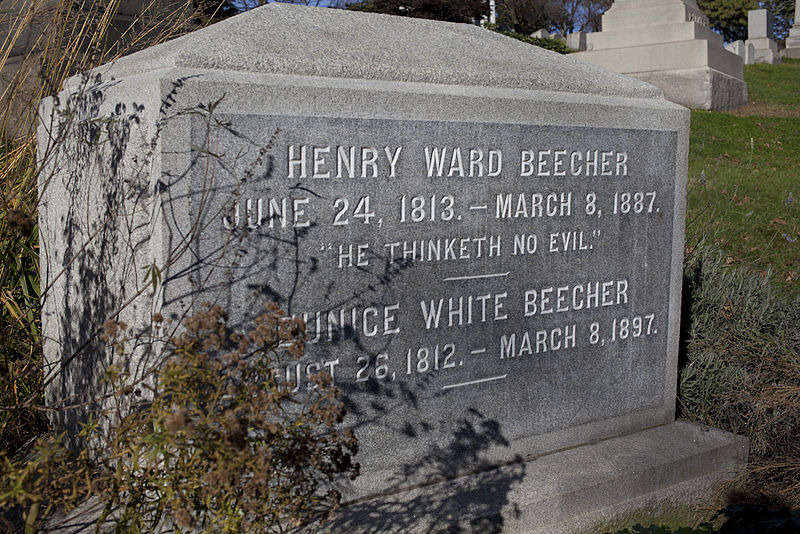
Henry Ward Beecher Grave, Greenwood Cemetery
Henry Ward Beecher was buried in Brooklyn's Greenwood Cemetery.


Beecher Gravestone

"HE THINKETH NO EVIL"


Beecher was survived by his wife Eunice, and four of the children born to them: Harriet, Henry, William Constantine and Herbert.

Eunice Beecher

In 1891, a bronze statue by sculptor John Quincy Adams Ward (1830–1910) honored Beecher; Ward was chosen to make Beecher’s death mask, and then selected by the memorial committee to sculpt his full-scale bronze effigy.  The piece placed the cloaked Beecher atop a granite pedestal. Attached to the base on one side is the figure of an African-American girl placing a palm branch at his feet, and on the other side a boy assists a girl laying a garland. Beecher is depicted in a pensive manner; the figures beside the base symbolize his devotion to children and his support of abolitionism. 

Though there were repeated attempts to place the statue in Prospect Park, it was installed instead in front of Brooklyn Borough Hall, and dedicated before 15,000 spectators on June 24, 1891. 

In 1940 it was relocated and restored, and in 1960 it was relocated again to its current location at the north end of Columbus Park. 

Henry Ward Beecher Monument
Brooklyn, New York