Sunday, March 10, 2013

John McLean, born March 11, 1785


John McLean was born in Morris County, New Jersey, on March 11, 1785, the son of Fergus McLean and Sophia Blackford. After living in a succession of frontier towns in Virginia and Kentucky, in 1797 his family settled in Warren County, Ohio.   

He was born two years after the end of the Revolutionary War, and died a week before the beginning of the Civil War.


He read law and was admitted to the bar in 1807. That same year he founded The Western Star,  a weekly newspaper at Lebanon, the Warren County seat, where he practiced law. He was elected to the U.S. House, serving from March 4, 1813, until he resigned in 1816 to take a seat on the Ohio Supreme Court, to which he had been elected on February 17, 1816.

He resigned his judgeship in 1822 to take President James Monroe's appointment to be Commissioner of the General Land Office, serving until 1823, when Monroe appointed him United States Postmaster General. McLean served in that post from December 9, 1823, to March 7, 1829, under Monroe and John Quincy Adams, presiding over a massive expansion of the Post Office into the new western states and territories and the elevation of the Postmaster Generalship to a cabinet office.

McLean was appointed to the Supreme Court by Jackson on March 6, 1829.  Known as "The Politician on the Supreme Court," he associated himself with every party on the political spectrum, moving from a Jackson Democrat, to the Anti-Jackson Democrats, the Anti-Masonic Party, the Whigs, the Free Soilers, and finally the Republicans. Through the 1830s and 1840s, he was frequently discussed as a potential Whig presidential candidate. 
Dred Scott
In the 1857 decision on Dred Scott v. Sandford, his strong dissenting views are believed to have forced the hand of Chief Justice Roger B. Taney into a harsher and more polarizing opinion than he originally planned. To the argument that "a colored citizen would not be an agreeable member of society", McLean responded, "This is more a matter of taste than of law."

Because of his anti-slavery-extension positions, he was considered by the new Republican party as a candidate in 1856. Despite his efforts, the nomination went to John Fremont.  In 1860, he tried again, winning twelve votes on the first ballot at the Republican convention in Chicago;  Abraham Lincoln ultimately was nominated.

He died in Cincinnati, Ohio on April 4, 1861, at the age of 76. 

He was buried in Spring Grove Cemetery, Cincinnati.

His son, Nathaniel McLean, was a Union general in the Civil War.  

During the war, Camp John McLean, a Union Army training camp in Cincinnati, was named in his honor.

Ralph Ellison, born March 1, 1914


Ralph Ellison, named after Ralph Waldo Emerson, was born in Oklahoma City, Oklahoma, to Lewis Alfred Ellison and Ida Millsap. He was the grandson of former slaves.  Lewis Alfred Ellison, a small-business owner and a construction foreman.  Lewis, who loved children and read books voraciously, worked as an ice and coal deliverer. He died from a work-related accident when Ellison was only three years old. His mother Ida then raised Ralph and younger brother Herbert by herself, working a variety of jobs to make ends meet.  Many years later, Ellison would find out that his father hoped he would grow up to be a poet.

Ellison was born about 50 years after the end of the Civil War.


In 1933, Ellison entered the Tuskegee Institute on a scholarship to study music. Tuskegee's music department was perhaps the most renowned department at the school, headed by the conductor William L. Dawson. Ellison also had the good fortune to come under the close tutelage of the piano instructor Hazel Harrison. While he studied music primarily in his classes, he spent increasing amounts of time in the library, reading up on modernist classics. He specifically cited reading T. S. Eliot's The Waste Land as a major awakening moment for him.


In 1936, Ellison went to New York over the summer with the intent of earning enough money to pay for his college expenses, but ended up relocating. Ellison had every intention of returning to Tuskegee. But the Great Depression prevented him from earning the needed funds. He studied sculpture and photography. He made acquaintance with the artist Romare Bearden. Perhaps Ellison's most important contact would be with the author Richard Wright, with whom he would have a long and complicated relationship. After Ellison wrote a book review for Wright, Wright encouraged Ellison to pursue a career in writing, specifically fiction. The first published story written by Ellison was a short story entitled "Hymie's Bull," a story inspired by Ellison's hoboing on a train with his uncle to get to Tuskegee.

Wright was then openly associated with the Communist Party and Ellison was publishing and editing for communist publications, although his "affiliation was quieter," according to historian Carol Polsgrove in Divided Minds. Both Wright and Ellison lost their faith in the Communist Party during World War II when they felt the party had betrayed African Americans and replaced Marxist class politics with social reformism. In a letter to Wright, August 18, 1945, Ellison poured out his anger with party leaders: "If they want to play ball with the bourgeoisie they needn't think they can get away with it. ... Maybe we can't smash the atom, but we can, with a few well chosen, well written words, smash all that crummy filth to hell." 
In the wake of this disillusion, Ellison began writing Invisible Man, a novel that was, in part, his response to the party's betrayal.
Invisible Man, by Ralph Ellison
World War II was nearing its end when Ellison, reluctant to serve in the segregated army, chose merchant marine service over the draft. In 1946 he married his second wife, Fanny McConnell. She worked as a photographer to help sustain Ellison. From 1947 to 1951 he earned some money writing book reviews, but spent most of his time working on Invisible Man. Fanny also helped type Ellison's longhand text and assisted her husband in editing the typescript as it progressed.
Published in 1952, Invisible Man explores the theme of man’s search for his identity and place in society, as seen from the perspective of an unnamed black man in the New York City of the 1930s. In contrast to his contemporaries such as Richard Wright and James Baldwin, Ellison created characters that are dispassionate, educated, articulate and self-aware. Through the protagonist, Ellison explores the contrasts between the Northern and Southern varieties of racism and their alienating effect. 
The narrator is "invisible" in a figurative sense, in that "people refuse to see" him, and also experiences a kind of dissociation. The novel, with its treatment of taboo issues such as incest and the controversial subject of communism, won the 1953 U.S. National Book Award for Fiction.
Ralph and Fanny Ellsion lived together in an apartment on Riverside Drive in New York City until Ellison died on April 16, 1994, of pancreatic cancer, and was buried at Trinity Church Cemetery in New York City.
Sculpture memorial to Ralph Ellison and "Invisible Man"
The Ralph Ellison Memorial is a sculpture 15 feet high at Riverside Drive and 150th Street, near an apartment building where Ellison lived for many years.   The design of the memorial, by Elizabeth Catlett, gives form to the sense of invisibility by presenting a cutout of a forceful male figure in a large bronze rectangle. The sculpture sits in a landscaped island at the end of the street and places the silhouetted form against the backdrop of the trees and river views in Riverside Park, where Ellison loved to sit.


Battle of Monroe's Crossroads, March 10,  1865
Monument honoring both Confederate and Union forces; erected on the site of the battle by the U.S. Army Corps of Engineers in 1996 just south of burial area C

The Battle of Monroe's Crossroads (also known as the Battle of Fayetteville Road, and colloquially in the North as Kilpatrick's Shirttail Skedaddle) was a battle during the Carolinas Campaign of the American Civil War in Cumberland County, North Carolina (now in Hoke County), on the grounds of the present day Fort Bragg Military Reservation

Involving about 4,500 men, it pitted mounted Confederate cavalry against dismounted Union cavalry. It was one of the last all-cavalry battles of the Civil War. The inconclusive fighting lasted for several hours early on the morning of March 10, 1865. The Confederate attack delayed the Federal cavalry's movement toward Fayetteville, denying Brevet Maj. Gen. Hugh Judson Kilpatrick the honor of entering the town first.

The main Confederate assault was at dawn and against a poorly guarded and sleeping Union camp. In command of the Confederate forces were Lt. Gen. Wade Hampton and Maj. Gen. Joseph Wheeler, who were operating together for the first time. 

One of the goals (not fulfilled) was the capture of Kilpatrick himself, using a small elite squadron of hand-picked troopers. Kilpatrick, ensconced with his mistress in a small log cabin near the farmhouse of Charles Monroe, managed to flee the chaotic scene in his nightshirt, hiding for a period in a nearby swamp before regaining his composure and reorganizing his troops. 

While initially routed, the Federal cavalry soon recovered and counterattacked, eventually pressuring the Confederates to relinquish the camp. Anticipating the approach of Union infantry, the Confederate commanders ordered their troops to disengage from the action in the mid-morning. Hampton's cavalry finally withdrew in good order toward Fayetteville.

The Battle of Monroe's Crossroads gained the additional time needed for the Confederate infantry to conduct an organized crossing of the Cape Fear River at Fayetteville unmolested by the advancing Federals. With their troops and equipment east of the Cape Fear, the Confederates burned the bridges as Union forces entered the city.

The actual loss to the Confederate forces during the Battle of Monroe's Cross Roads is unknown, but it was said that every house along the road was full of killed and wounded soldiers. Out of Hampton's two brigades, 86 troops were reported left dead on the field. Major Christopher T. Cheek of the 5th Kentucky reported counting 33 dead Confederates within the limits of his camp, including many officers. Ten days after the battle, a commissioned officer, William F. Sewell of the 5th Georgia Cavalry, was found lying about a half mile from the battlefield within arm's reach of a small stream called Persimmon Branch. His body was lying on a pallet made from a small part of a tent with a collapsible rubber cup lying by his side. His black horse, his only companion, had remained near him, cropping the wire grass for a considerable space around.

There is no accurate number of Union casualties, and the existing accounts are confusing and contradictory. In his report to Sherman, Kilpatrick reported that he lost '4 officers killed and 7 wounded, 15-[19] men killed and 61-[75] severely and several slightly wounded, and 103 officers and men taken prisoner. The enemy left in our camp upward of 80 killed, including many officers and a large number of men wounded [about 30]…150 horses with their equipment.' Kilpatrick also lost around 30 valuable horses from his headquarters, including four of his own personal mounts: 'two fine stallions–one a little spotted horse, and a large gallant black–and a pie bald and a bay.'

In a report to U.S. Assistant Secretary of War Charles Dana, Lt. Gen. Ulysses S. Grant stated: 'Sherman from Fayetteville on the 12th. He says nothing about Kilpatrick's defeat by Hampton. Hampton captured all the staff but two officers.' This limited statement of fact was publicly released on March 17 to The New York Times, doubtless to Kilpatrick's great chagrin.

Months after the battle, the remains of cavalrymen who had been buried hurriedly were partially exposed by the rain and wind. Fleshless faces peered up from one grave and bony hands stretched forth from others. Soon after the war ended, the Confederate dead were reburied by local citizens. Under the leadership of Captain John McKeller, John H. Currie and others, the bodies were given a proper burial. About 30 to 35 unknown Confederate dead who fell during the Battle of Monroe's Cross Roads are buried in a mass grave at Longstreet Church Cemetery, marked with a simple marble shaft bearing the inscription 'Confederate Soldiers.' The remainder were removed and buried in the Fayetteville Cemetery.

The Federals killed during the battle were interred on the battlefield. In 1921, the Quartermaster Corps at Fort Bragg identified 33 Federal unknown graves with markers throughout the reservation. Today, the battlefield site is an artillery impact area at Fort Bragg. The farmhouse has since burned, and the gravestones are hidden throughout the woods. About 200 yards west of where the house and old road once were, 27 Union soldiers are buried in three graves.

CNN newsman Anderson Cooper is Hugh Judson Kilpatrick's great-great-grandson.
Kilpatrick's great-great-grandson, Anderson Cooper

Saturday, March 9, 2013

Simon Cameron, born March 9, 1799


Simon Cameron was born in Maytown, Pennsylvania, the third son of Charles Cameron, a poor tailor, and Martha Pfoutz. When he was six, the struggling family moved to Sunbury. He was orphaned at nine.  At eleven, he was apprenticed to a printer, Andrew Kennedy, editor of the Northumberland Gazette

He was 62 years old when the Civil War began.

Washington, D.C. - 1822
He was editor of the Bucks County Messenger in 1821. A year later, he moved to Washington, D.C., and studied political movements while working for the printing firm of Gales and Seaton.  He married Margaret Brua and returned to Harrisburg, Pennsylvania where he purchased and ran the Republican in 1824.

Cameron served as state printer of Pennsylvania from 1825 until 1827 and was state adjutant general in 1826. He constructed several rail lines and merged them into the Northern Central Railway.  In 1829 he was appointed adjutant general of the state militia by Governor Shulze, his sister-in-law’s brother. Though he served but two years, he was known as “General” to the end of his life.

He founded the Bank of Middletown in 1832 and engaged in other business enterprises. In 1838, President Van Buren appointed him as commissioner to settle claims of the Winnebago Indians of the Wisconsin Territory for lands taken from them by the federal government. Cameron was accused of cheating the Indians,.  Rumors of alleged corruption provided his "Great Winnebago" nickname.
Cameron House and Bank, 
Middletown, Pennsylvania
Cameron became a Whig member, and later, around 1845, a Democrat. He was elected to replace James Buchanan in the United States Senate in 1844, serving until 1849.  He switched to the Republican Party. In 1856, Cameron was again elected to the United States Senate.
Cameron was nominated for president, but gave his support to Abraham Lincoln at the 1860 Republican National Convention.  Lincoln, after his election, appointed Cameron Secretary of War.  
Lincoln's Cabinet with Cameron as Secretary of War
There were charges of corruption in the War Department's awarding of contracts; Cameron himself was accused of profiting from the war by diverting traffic to his Harrisburg to Baltimore Railroad. Because of the allegations, he was forced to resign early in 1862.  Pennsylvania congressman, Thaddeus Stevens, when discussing Cameron's honesty with Lincoln, told Lincoln that "I don't think that he would steal a red hot stove."  When Cameron demanded Stevens retract this statement, Stevens told Lincoln "I believe I told you he would not steal a red-hot stove. I will now take that back."
John Usher, who also served in Mr. Lincoln's cabinet, recalled a dinner party where Cameron defended himself against any involvement in corrupt contracts, saying: "If I have any ability whatever, it is an ability to make money. I do not have to steal it. I can go into the street any day, and as the world goes, make all the money I want. It was absurd to accuse me of that. When the war broke out I knew that the railroad from Baltimore to Harrisburg, the Northern Central of Pennsylvania, was bound to be good property; the soldiers and people devoted to the preservation of the Union traveling to Washington would necessarily be transported over it. The stock was then worth only a few cents on the dollar. I knew that from the very necessity of the case it would advance in value to par or nearly so. I bought large blocks of this stock, and told Mr. Lincoln if he would give me ten thousand dollars I would make him all the money he wanted." Cameron said the President declined his offer.
It was harder to defend himself against charges of incompetence. “We were entirely unprepared for such a conflict, and for the moment, at least, absolutely without even the simplest instruments with which to engage in war,” Cameron later remembered. “We had no guns, and even if we had, they would have been of but little use, for we had no ammunition to put in them – no powder, no saltpetre, no bullets, no anything.”
Cameron served until removal in January 1862 for mismanagement, corruption and abuse of patronage.  Simon Cameron was succeeded as Secretary of War by Edwin Stanton, who had been serving as a legal advisor to the War Secretary. Cameron then served as United States Minister to Russia Cameron did not rush to Russia. He had no desire to experience Moscow in winter and never did. He waited until May to leave and came back in November 1862—spending most of his time in travels across Europe.  Stopping in England, France, Italy and the German states, Cameron was shopping for furnishings for his new house. In the parlor are two 14-foot tall pier mirrors as well as mirrors above the fireplaces which came from France. The fireplace mantles are hand-carved, Italian marble, and the alcove window glass is from Bavaria.  He also had the floor lowered 3 feet into the basement in the front section of the house because the 11-foot ceilings in the parlor could not accomodate his new 14-foot mirrors. 
Cartoon from February 1862: "Good-by . . . I'm off for Russia!
Cameron's brother, James Cameroncolonel of the 79th New York Volunteer Infantry Regiment, was killed in action at the First Battle of Bull Run on July 21, 1861.

In 1866, Cameron was again elected to the Senate and served there until 1877, when on assurances from the Pennsylvania General Assembly that his son, James Donald Cameron, would be the successor to his seat, he resigned. His son had already been named as Secretary of War in 1876.
Cameron House
Cameron retired to his farm at Donegal Springs Cameron Estate near Maytown, Pennsylvania, where he died of a stroke on June 26, 1889 at the age of 90. 

He is buried in the Harrisburg Cemetery in Harrisburg, Pennsylvania.


U.S.S. Monitor battles C.S.S. Virginia, March 9,  1862
On March 9, 1862, the U.S.S. Monitor and the C.S.S. Virginia fought to a draw off Hampton Roads, Virginia. The ships pounded each other all morning but their armor plates easily deflected the cannon shots, signaling a new era of steam-powered iron ships.

The Battle of Hampton Roads, often referred to as either the Battle of the Monitor and Merrimack (or Virginia) or the Battle of Ironclads, was the most noted and arguably most important naval battle of the American Civil War from the standpoint of the development of navies.  The battle was a part of the effort of the Confederacy to break the Union blockade, which had cut off Virginia's largest cities, Norfolk and Richmond, from international trade.

The major significance of the battle is that it was the first meeting in combat of ironclad warships. The Confederate fleet consisted of the ironclad ram CSS Virginia (built from the remnants of the USS Merrimack) and several supporting vessels. On the first day of battle, they were opposed by several conventional, wooden-hulled ships of the Union Navy. On that day, Virginia was able to destroy two ships of the Federal flotilla, USS Congress and USS Cumberland, and was about to attack a third, USS Minnesota, which had run aground. However, the action was halted by darkness and falling tide, so Virginia retired to take care of her few wounded — which included her captain, Flag Officer Franklin Buchanan — and repair her minimal battle damage.
Determined to complete the destruction of the Minnesota, Catesby ap Roger Jones, acting as captain in Buchanan's absence, returned the ship to the fray the next morning, March 9. 
CSS Virginia
During the night, however, the ironclad USS Monitor had arrived and had taken a position to defend Minnesota. When Virginia approached, Monitor intercepted her. The two ironclads fought for about three hours, with neither being able to inflict significant damage on the other. The duel ended indecisively, Virginia returning to her home at the Gosport Navy Yard for repairs and strengthening, and Monitor to her station defending Minnesota. The ships did not fight again, and the blockade remained in place.

The battle received worldwide attention, and it had immediate effects on navies around the world. The preeminent naval powers, Great Britain and France, halted further construction of wooden-hulled ships, and others followed suit. A new type of warship was produced, the monitor, based on the principle of the original. The use of a small number of very heavy guns, mounted so that they could fire in all directions was first demonstrated by Monitor but soon became standard in warships of all types. Shipbuilders also incorporated rams into the designs of warship hulls for the rest of the century.

USS Monitor
After the Confederates were forced to destroy the Virginia in early May, Monitor sailed up the James River to support the Army during the Peninsula Campaign. The ship participated in theBattle of Drewry's Bluff later that month and remained in the area until she was ordered to join the blockaders off North Carolina in December. She foundered while under tow during a storm off the coast of Cape Hatteras on the last day of 1862.
 Her wreck was discovered in 1973 and has been partially salvaged. Monitor's armament, gun turret, engine and other relics are on display at the Mariners' Museum in Newport News, Virginia


A century and half after their deaths aboard one of history’s most famous warships, two sailors from the USS Monitor were laid to rest at sunset, March 9, 2013 on a hillside in Arlington National Cemetery.

In what might be the last funeral of the American Civil War, the two shipmates were buried with elaborate military honors, their flag-covered caskets carried on horse-drawn caissons as a throng of dignitaries, crew descendants and bystanders looked on.
Facial reconstruction of the two unknown sailors from USS Monitor
The burial came on a blustery afternoon that was one day short of the 151st anniversary of the Union ship’s legendary battle in Hampton Roads, Va., with the Confederacy’s CSS Virginia, formerly the USS Merrimack.
It followed a crowded religious service at the Ft. Myer chapel adjacent to the cemetery, where eulogists called them brave sailors and noble souls and sang them a Navy hymn. A painting of the Monitor sinking stood in the front of the chapel, flanked by two tall candles.
The sailors were two of the 16 men who perished when the Monitor sank in a storm off Cape Hatteras in 1862. The Navy said a gravestone bearing the names of all 16 men will be erected later.
The lost 16 sailors were a kind of cross section of mid-19th-century America: three African Americans, two natives of Ireland, one each from Scotland, England, and Wales, and a coal heaver from Maine, among others.
Almost 10 months after the March 9, 1862, Hampton Roads battle, the two sailors buried Friday were aboard the Monitor when it sank in a gale off the North Carolina coast on Dec. 31, 1862. The ship capsized and settled on the bottom upside down.
In 2002, more than a century after the ship sank, the almost-complete skeletons were found, one on top of the other, amid a tangle of huge guns and debris in the turret.

Friday, March 8, 2013

Emily Parsons, born March 8, 1824

Emily Parsons was born on March 8, 1824 in Taunton, Massachusetts, the daughter of Professor Theophilus Parsons of the Harvard Law School and granddaughter of the late Chief Justice Parsons of Massachusetts. She was educated in Boston.

She was 37 years old and living in Cambridge at the beginning of the Civil War.

Fort Schuyler


Fort Schuyler Hospital
She had a strong desire to enlist in the army as a nurse, despite impaired vision, some deafness from scarlet fever and lameness. Her father was reluctant but finally agreed, and at the age of 37, Parsons enrolled in nursing school at Massachusetts General Hospital in preparation for caring for sick and wounded Union soldiers.

After eighteen months of training, she was placed in charge of a ward attending fifty wounded soldiers at Fort Schuyler Military Hospital on Long Island in October 1862. For two months, she performed the duties of hospital nurse, but her health deteriorated further.
After a rest, Parsons wrote to Dorothea Dix, superintendent of Union nurses, offering her services wherever they might be needed. At the same time, she became friends with Jessie Benton Fremont, who recommended Parsons to the Western Sanitary Commission at St. Louis, and she was immediately telegraphed to come at once to St. Louis.  Every available building in St. Louis was converted into a hospital, and the sick and wounded were brought from Vicksburg, Arkansas Post and Helena up the river to be cared for at St. Louis and other military posts. At Memphis and Mound City (near Cairo), at Quincy, Illinois, and the cities on the Ohio River, the hospitals were in an equally crowded condition.

In January, 1863, Parsons went to St. Louis, and was assigned by James E. Yeatman, president of the Western Sanitary Commission, to the Lawson Hospital.  A few weeks later, she was placed as head nurse on the hospital steamer City of Alton. A large supply of sanitary stores were entrusted to her care, and the steamer proceeded down the Mississippi River.
The City of Alton Steamboat
At Vicksburg, Mississippi the ship was loaded with four hundred invalid soldiers, many of them sick past recovery, and returned as far as Memphis. On this trip, the strength and endurance of Parsons were tried to the utmost in caring for the helpless and suffering men, several of whom died on the passage up the river. During this period, she contracted malaria.  At Memphis, after transferring the sick to the hospitals, an order was received from General Ulysses S. Grant to load the boat with troops and return immediately to Vicksburg, and Parsons and the other female nurses were returned to St. Louis.

For a few weeks after her return, Parsons suffered from an attack of malarious fever.  On her recovery she was assigned to duty as superintendent of female nurses at the Benton Barracks Hospital, the largest of all the hospitals in St. Louis, built out of the amphitheatre and other buildings at the fair grounds of the St. Louis Agricultural Society.  In this large hospital, there were often two thousand patients, and besides the male nurses detailed from the army, the corps of female nurses consisted of one to each ward, whose duty it was to attend to the special diet of the weaker patients, to see that the wards were kept in order, the beds properly made, the dressing of wounds properly done, to minister to the wants of the patients, and to give them words of good cheer, both by reading and conversation – softening the rougher treatment and manners of the male nurses.

The monotonous army diet of hard bread, salted meat, and coffee without milk needed to be supplemented with fruits, vegetables and dairy products; and inexperienced soldiers needed to learn about proper drainage in the camps and how to set up tents for maximum ventilation. Parsons and others took it upon themselves to give proper attention to the dietary needs and hygiene of the soldiers.


After serving six months in this capacity, recurrent malarial fever sent Parsons back home to Massachusetts. After a short rest, she returned to St. Louis and resumed her position at Benton Barracks. She continued to work there until August 1864, when ill health sent her home again.

By the time she recovered, the war was over, and she devoted herself at home to working for the freedmen and refugees. She collected clothing and garden seeds for them, many boxes of which she shipped to the Western Sanitary Commission at St. Louis to be distributed in the Mississippi Valley, where they were greatly needed.

In the spring of 1865, she took a great interest in the Sanitary Fair held at Chicago, collected many valuable gifts for it, and was sent for by the Committee of Arrangements to go out as one of the managers of the department furnished by the New Jerusalem Church – the different churches having separate departments in the Fair.


Parsons raised money to establish her own charity hospital for women and children, which she opened in 1867 in Cambridgeport. After a year, the hospital was forced to move, but reopened in 1869 as the Cambridge Hospital for Women and Children, operating from a rented house. It closed in 1871 for lack of funds.

Emily Elizabeth Parsons died of a stroke on May 19, 1880. 


Parsons Building, Mount Auburn Hospital
Efforts to raise funds for a hospital continued in her memory. In 1883, Dr. Morrill Wyman purchased a nine-acre plot on the Charles River near Gerry's Landing, and the building of Mount Auburn Hospital began. The first hospital structure was completed in 1886, and named the Parsons Building in Emily's honor.

After her death, her father published her correspondence detailing her experiences as a war nurse, Memoir of Emily Elizabeth Parsons.
General Ulysses Grant meets Abraham Lincoln, March 8,  1864
General Ulysses Grant was named General-in-Chief of the Army in March 1864,  Historian Jean Edward Smith wrote: "The White House had designated a welcoming committee to meet the train and escort him to his hotel, but the arrangements fell through and no was on hand when he arrived on the afternoon of March 8...."

He and his son Fred, 13, checked in Willard's Hotel on March 8, 1864. The travel-weary and unprepossessing union officer was not recognized on signing in and was assigned to an undesirable room on the top floor before the clerk read his signature. Grant simply did not look like the highest-ranking officer in the Union Army. 
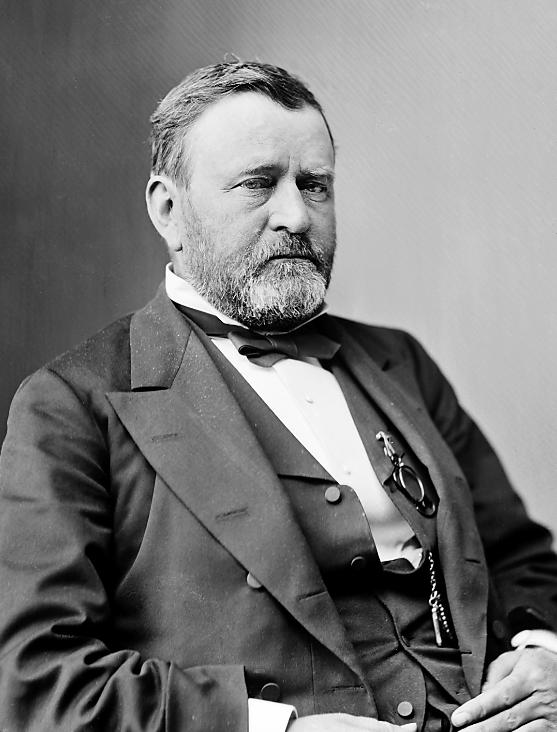
Ulysses Grant

Lobby of Willard Hotel
His appearance in the Willard's dining room caused a stir -- especially after Congressman James Moorhead announced: "Ladies and gentlemen: The hero of Donelson, of Vicksburg, and of Chattanooga is among us. I propose the health of Lieutenant-General Grant." 

A chant of "Grant! Grant! Grant!" was soon taking up by the diners, who rushed to his table to congratulate him. When it became evident that a peaceful dinner was out of the question, the general and his son retired to their room.
"That evening, as it chanced, was the occasion of the usual weekly reception at the White House, and thither General Grant went by special invitation," a reporter, Noah Brooks, wrote. "Thither too went throngs of people when it was known that he would be on view with the President. So great was the crowd, and so wild the rush to get near the general, that he was obliged at last to mount a sofa, where he could be seen, and where he was secure, at least for a time, from the madness of the multitude. People were caught up and whirled in the torrent which swept through the great East Room. Ladies suffered dire disaster in the crush and confusion; their laces were torn and crinolines mashed; and many got upon sofas, chairs, and tables to be out of harm's way or to get a better view of the spectacle. It was the only real mob I ever saw in the White House. It was an indescribable scene of curiosity, joy, and pleasure. For once at least the President of the United States was not the chief figure in the picture. The little, scared-looking man who stood on a crimson-covered sofa was the idol of the hour. He remained on view for a short time; then he was quietly smuggled out by friendly hands."

Grant's son remembered: "As my father entered the drawing-room door at the White House, the other visitors fell back in silence, and President Lincoln received my father most cordially, taking both his hands, and saying, "I am most delighted to see you, General."


In his memoirs, Grant wrote: "I never met Mr. Lincoln until called to the capital to receive my commission as lieutenant-general. I knew, however, very well and favorably from the accounts given by officers under me at the West who had known him all their lives. I had also read the remarkable series of debates between Lincoln and Douglas a few years before, when they were rival candidates for the United States Senate. I was then a resident of Missouri, and by no means a 'Lincoln man' in that contest; but I recognized then his great ability."

The next day, with Fred, Rawlins, and Comstock in tow, he made his way first to Halleck's office, then to Stanton's, and then back to the White House, arriving in time for the one o'clock ceremony." Grant aide Porter wrote: "The next day, March 9, the general went to the White House, by invitation of Mr. Lincoln, for the purpose of receiving his commission from the hands of the President. Upon his return to Willard's Hotel, I called to pay my respects. Curiosity led me to look at the hotel register, and the modesty of the entry upon the book, in the general's handwriting, made an impression upon me. It read simply, 'U.S. Grant and son, Galena, Ill.'" 

Lincoln aide Edward Duffield Neill, who worked on the second floor of the White House, wrote: "About two o'clock in the afternoon of the 9th of March, 1864, a messenger told me to look out of the window of my room and I would see General Grant. I went, and saw a plain, round-shouldered man in citizen's dress, with a lad, his eldest son, by his side, walking away from the house, where he had been to pay his visit to the President."